How many bartenders for 100 guests? Plan on 2 bartenders for a standard open bar, and 2 to 3 if your cocktail hour is fast-paced or the menu leans on shaken signature cocktails. The ratio behind that number is one bartender per 50 to 75 guests at an open bar, or one per 35 to 50 guests when everyone hits the bar at once.
The guest count is only half the math. What you pour, when guests arrive at the bar and how the bar is laid out decide whether 2 bartenders feels relaxed or overwhelmed. Below you’ll find a staffing table for 50 to 300 guests, the drink-volume math behind it and the situations where adding a bartender or a barback pays off.
Staffing is also the biggest variable in your bar budget, so if you are pricing the whole thing, our guide to what an open bar costs for 100 wedding guests breaks down the alcohol and service side together.
How many bartenders you need, by guest count
These figures follow the staffing guideline we use at Magic & Cocktails across more than 900 events since 2018: one bartender per 50 to 75 guests at a standard open bar, and one per 35 to 50 guests for a fast-paced cocktail hour.
| Guests | Standard open bar | Fast-paced cocktail hour or full cocktail menu |
|---|---|---|
| 50 | 1 bartender | 1 to 2 bartenders |
| 75 | 1 to 2 bartenders | 2 to 3 bartenders |
| 100 | 2 bartenders | 2 to 3 bartenders |
| 150 | 2 to 3 bartenders | 3 to 5 bartenders |
| 200 | 3 to 4 bartenders | 4 to 6 bartenders |
| 250 | 4 to 5 bartenders | 5 to 8 bartenders |
| 300 | 4 to 6 bartenders | 6 to 9 bartenders |
Use the low end of each range for beer and wine with one signature cocktail, and the high end for a full bar with shaken or muddled drinks.
Is one bartender enough for 100 guests?
Only for a relaxed beer-and-wine event where guests arrive gradually. For anything with cocktails, one bartender serving 100 people means a line for most of the first hour, and a line at the bar is the first thing guests remember about service.
The drink math behind the ratio
Our planning rule is 2 drinks per guest in the first hour and 1 per hour after that. For 100 guests at a five-hour reception, that comes to about 600 drinks, but 200 of them land in the first 60 minutes. That front-loaded hour is what you staff for, not the evening average.
The Knot’s alcohol guidance points the same way: guests drink more early in an event and slow down later, which is why the drinks per guest per hour run higher for events under three hours. A short party with a hard start time needs proportionally more bar staff than a long, slow-burning reception.
The menu then sets the speed. Opening a beer or pouring wine takes seconds; a shaken cocktail with fresh citrus and a garnish takes much longer, and a full bar where every guest orders something different is the slowest service of all.
Cocktail hour is the bottleneck
At most weddings and parties the busiest stretch is the first hour, right after the ceremony or the moment doors open. If the staffing works for that hour, the rest of the night takes care of itself. Four ways to get through it without adding headcount:
- Batch the signature cocktails. Pre-mixed in advance, a signature drink pours almost as fast as wine.
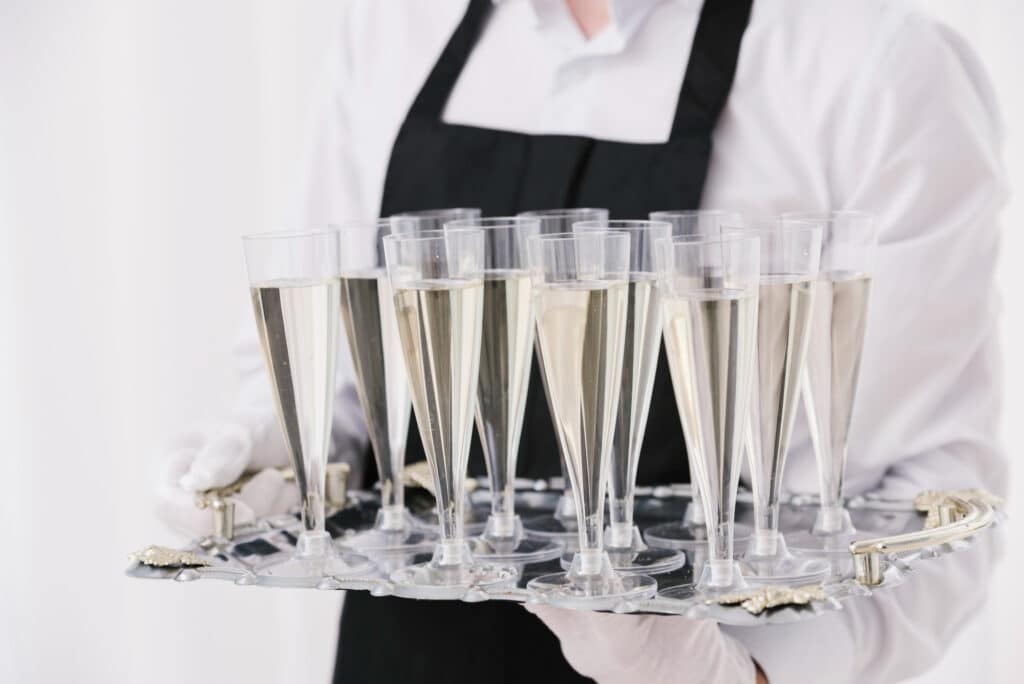
- Greet guests with a drink. A tray of sparkling wine or a welcome cocktail at the entrance takes the first wave off the bar.
- Keep the menu short. Two or three cocktails plus beer and wine move faster than an open-ended full bar.
- Put a menu sign on the bar. Guests who decide before they reach the front order faster.
When to add a barback or a second bar
A barback restocks ice, glassware and bottles and clears empties, so the bartenders never leave their station. Add one when you are serving a full bar, using real glassware or expecting more than 150 guests. Ice alone justifies it at scale: we plan 2 lbs of ice per guest, which is 200 lbs for 100 guests and 400 lbs for 200.
How many bars for 100 guests?
One bar with 2 bartenders works for 100 guests in most layouts. A second station makes sense when the cocktail hour and the reception happen in different spaces, when the venue is spread out or when you want beer and wine served separately from cocktails. Two bars with one bartender each are often slower than one bar with two, because a lone bartender has no one to cover restocking.
What extra bartenders add to the budget
Every bartender you add is billed for the full shift, usually including setup and breakdown time. For a 100-guest event, the difference between 2 and 3 bartenders is one extra shift, which is often cheaper than it looks next to the cost of an hour-long line. For hourly rates, minimums and the fees couples tend to miss, see our breakdown of how much wedding bartenders charge and what drives the total.
Whoever you hire in California, every bartender on the team needs a current Responsible Beverage Service certification, mandatory for alcohol servers since July 1, 2022 under the California ABC RBS program.
Staffing your wedding bar in Los Angeles
When you book Magic & Cocktails, staffing is calculated from your guest count, your menu and your timeline, not from a flat package. Our team arrives 60 to 90 minutes before the first guest to build the bar, every bartender is RBS certified and covered by liquor liability insurance, and the menu is designed in advance so the first hour runs at full speed.
If you are planning a wedding, send us your date and guest count and we’ll size the team for you through our wedding bartending service in Los Angeles, staffed to your guest count.