A signature cocktail is a drink chosen by the couple and served all night under its own name. Most weddings work best with two of them plus one zero-proof option: enough to feel personal, few enough that the bar can pour them fast when 120 people arrive at once. Everything below is organized the way a bar team actually plans a wedding, so you are picking drinks that survive a tray, a warm afternoon and a queue.
We have run the bar at 900+ events across Los Angeles County since 2018, and the pattern is consistent: the cocktails couples fall in love with on Pinterest are often the ones that collapse in service. Muddled herbs go black. Egg white foam dies in four minutes. Anything with fresh mint takes ninety seconds a drink, which is how a fifteen-minute queue forms. The list below filters for drinks that hold up. If you want the bar planned around your run of show rather than just the recipes, that is what our wedding bartending team in Los Angeles does.
How many signature cocktails should you have at your wedding?
Two alcoholic signatures and one zero-proof drink. That is the number that works for almost every guest list.
The reason is service speed, not decoration. Every additional signature adds a set of bottles, a garnish tray and a decision for the guest standing at the bar. Two options let a bartender pre-batch both, line up the glassware and pour without asking questions. Three or more and the batching advantage disappears, because the bar has to keep four or five prepped components alive at the same time.
Pick one short and spirit-forward, one long and refreshing. That covers almost everyone: the guests who want something they can sip for an hour, and the guests who want a drink that tastes like a holiday. Add a zero-proof version built with the same care and you have also covered the designated drivers, the pregnant guests and anyone not drinking, without handing them a glass of soda.
What makes a good wedding signature cocktail
Before you fall for a recipe, run it through six checks. These are the questions a bar team asks about every drink a couple proposes.
- Can it be batched? Everything except the sparkling element and the ice should be able to sit premixed in a container. If a drink must be built one at a time in the glass, it will not survive a cocktail hour.
- Does it survive twenty minutes on a tray? Passed drinks sit around. Anything foamed, frozen or heavily carbonated is a bar-only drink, not a tray drink.
- Is the spirit under two ounces? Guests drink these for five or six hours. A three-ounce pour tastes generous at 6pm and shows up in the speeches at 9pm.
- Does the color photograph? Brown and pale yellow disappear in photos. Pink, coral, deep red, bright green and anything cloudy-white read well on camera and in the hands of your guests.
- Does it avoid muddling and egg? Muddled mint, basil and berries oxidize and slow service to a crawl. Egg white foam collapses long before the drink is drunk.
- Does it have a zero-proof twin? The best signatures can be made without the spirit and still taste like a drink. That is how the non-drinkers get the same glass as everyone else.
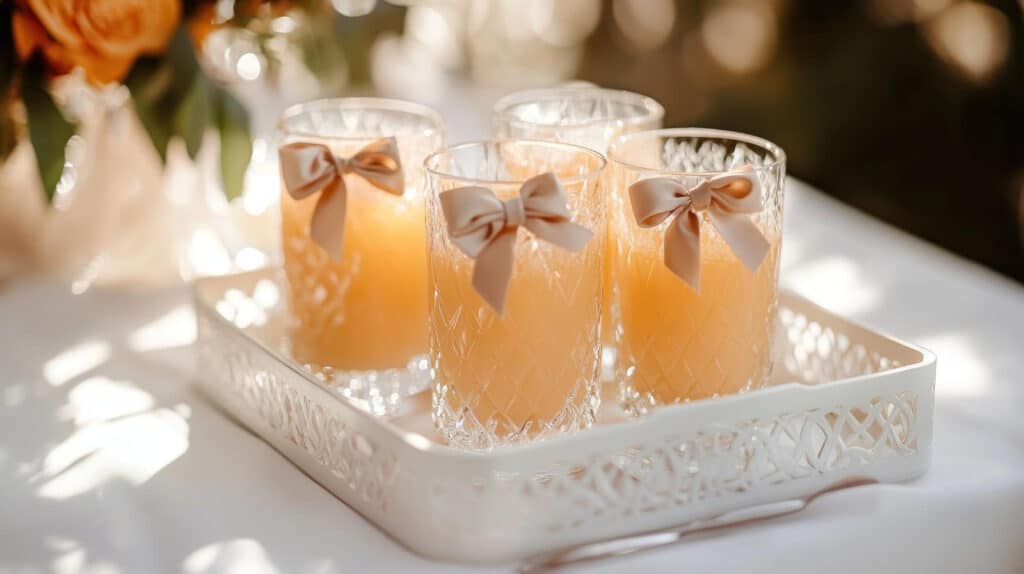
His and hers signature cocktails: 5 pairings that work together
The most common format is one drink each. The trick is to make them feel like a set rather than two unrelated recipes, so pair them by contrast: one short, one long, and a shared ingredient or color story running through both.
Sparkling Hibiscus Spritz and Oaxaca Old Fashioned
The spritz is 1 oz blanco tequila, 0.75 oz hibiscus syrup, 0.5 oz lime, topped with sparkling wine. The Old Fashioned is 1.5 oz reposado tequila, 0.25 oz agave, two dashes of chocolate bitters and a grapefruit twist. Both are agave-based, which means one bottle backbone and two very different drinks.
Elderflower Gin Fizz and Rye Manhattan
The fizz is 1.25 oz gin, 0.5 oz elderflower liqueur, 0.5 oz lemon, topped with soda. The Manhattan is 2 oz rye, 1 oz sweet vermouth, two dashes of aromatic bitters, stirred and served up with a cherry. A classic pairing for a black-tie reception.
Watermelon Margarita and Smoked Maple Bourbon Sour
The margarita is 1.5 oz blanco tequila, 1 oz watermelon juice, 0.5 oz lime, 0.25 oz agave, with a chili-salt rim. The sour is 1.5 oz bourbon, 0.5 oz maple syrup, 0.75 oz lemon, finished with a smoke dome. A strong summer set, and the pink and amber contrast well in photos.
Passionfruit Bellini and Espresso Martini
The bellini is 1.5 oz passionfruit purée topped with prosecco. The espresso martini is 1.5 oz vodka, 0.75 oz coffee liqueur, 1 oz fresh espresso, shaken hard. Serve the bellini at the ceremony and hold the espresso martini for after dinner, when the room needs it.
Cucumber Lime Cooler and Aperol Negroni
The cooler is 1.25 oz gin, 1 oz cucumber juice (pressed, not muddled), 0.5 oz lime, 0.25 oz simple, topped with soda. The negroni is 1 oz gin, 1 oz Aperol, 1 oz sweet vermouth over a large cube. Both batch beautifully and neither needs a garnish more complicated than a peel.
Signature cocktails by season
Season matters more than trend. A February wedding in a heated ballroom and an August wedding on a Malibu terrace need different drinks, and the seasonal fruit is both cheaper and better.
Spring weddings
- Strawberry Basil Spritz: 1 oz vodka, 0.75 oz strawberry-basil syrup, 0.5 oz lemon, topped with soda. The basil goes into the syrup rather than the glass, so nothing goes black.
- Rhubarb Gin Collins: 1.25 oz gin, 0.75 oz rhubarb syrup, 0.75 oz lemon, topped with soda. Pale pink and very easy to drink at an afternoon ceremony.
- Lavender Lemon Drop: 1.5 oz vodka, 0.5 oz lavender syrup, 0.75 oz lemon, served up with a sugar rim. Keep the lavender light or it tastes like soap.
Summer weddings
- Frozen Coconut Daiquiri: 1.5 oz white rum, 0.75 oz coconut cream, 0.75 oz lime, blended. A bar-only drink, but the best thing you can hand someone at 95 degrees.
- Cantaloupe Paloma: 1.5 oz blanco tequila, 1 oz cantaloupe juice, 0.5 oz lime, topped with grapefruit soda and a salt rim.
- Mango Chili Margarita: 1.5 oz blanco tequila, 1 oz mango purée, 0.5 oz lime, 0.25 oz agave, with a Tajín rim. The chili keeps it from being a dessert.
Fall weddings
- Spiced Pear Bourbon Sour: 1.5 oz bourbon, 0.75 oz spiced pear syrup, 0.75 oz lemon. Warm-looking and still bright enough to drink for hours.
- Fig and Thyme Old Fashioned: 1.5 oz rye, 0.25 oz fig syrup, two dashes of aromatic bitters, thyme sprig. Thyme holds up in a glass where basil and mint do not.
- Apple Cider Mule: 1.25 oz vodka, 1 oz apple cider, 0.5 oz lime, topped with ginger beer. The easiest crowd-pleaser on this list.
Winter weddings
- Pomegranate French 75: 1 oz gin, 0.5 oz pomegranate syrup, 0.5 oz lemon, topped with champagne. Deep red, ideal for a toast.
- Spiced Cranberry Mule: 1.25 oz vodka, 1 oz spiced cranberry, 0.5 oz lime, topped with ginger beer.
- Salted Caramel Old Fashioned: 1.5 oz bourbon, 0.25 oz salted caramel syrup, two dashes of aromatic bitters, orange peel. Serve it after dinner, not before.
Signature drink ideas for the groom
This comes up in almost every planning conversation, and the answer is usually the same: the groom’s drink should be the short, spirit-forward half of the pair. Three that consistently work at weddings.
- Rye Boulevardier: 1.25 oz rye, 1 oz Campari, 1 oz sweet vermouth, orange peel. Bitter, stirred and impossible to make badly at volume.
- Islay Highball: 1.5 oz lightly peated Scotch topped with soda over a tall column of ice. Two ingredients, and the smoke makes it memorable without being heavy.
- Añejo Tequila Old Fashioned: 1.5 oz añejo tequila, 0.25 oz agave, two dashes of chocolate bitters. Reads like a whiskey drink to guests who think they do not like tequila.
Zero-proof signature drinks that are actually drinks
The non-alcoholic option is the one couples most often leave to the caterer, and it is the one guests remember when it is done properly. Give it a name and put it on the menu board next to the other two.
- Garden Spritz: 1.5 oz non-alcoholic botanical spirit, 0.5 oz lime, 0.5 oz cucumber juice, topped with tonic. Dry and bitter, which is what most zero-proof drinks are missing.
- Hibiscus Ginger Cooler: 1 oz hibiscus syrup, 0.75 oz lime, 1 oz strong ginger tea, topped with soda. Deep magenta, and it looks identical to the alcoholic spritz in photos.
- Espresso Tonic: 1 oz espresso over ice, topped with tonic and an orange twist. Bright, bitter and genuinely refreshing, and a fair alternative to the espresso martini after dinner.
Naming your signature cocktails
The name is what turns a cocktail into a signature. Three approaches that hold up better than a pun on your surname:
- The place: where you met, where you got engaged, where you are from. “The Silver Lake Spritz” tells a story in three words.
- The detail only you two know: the dog’s name, the wrong train, the terrible first restaurant. Guests ask about it, which is the point.
- His and hers as a pair: “Her Better Judgement” and “His Last Round” work because they only make sense together.
Print both names on a menu board at the bar and, if you want the detail, on an edible topper floating on the drink itself. Wafer paper printed with a monogram costs very little and it is the single most photographed thing we put on a wedding bar.
Scaling the recipes: quantities for 100 guests
Here is where most signature cocktail plans fall apart. A recipe for one glass tells you nothing about what to buy.
Plan on two drinks per guest in the first hour and one per hour after that. For 100 guests over five hours, that is roughly 600 drinks, of which the signatures typically take 40 to 60 percent. So budget 250 to 350 signature cocktails, split across your two recipes.
In practice, for 100 guests over five hours:
- Roughly 7 to 9 bottles (750 ml) of the base spirit per signature cocktail, at 1.5 oz per drink.
- 2 to 3 liters of syrup and 4 to 5 liters of citrus juice across both drinks. Squeeze citrus the same day, not the day before.
- 200 lbs of ice. The working figure is two pounds per guest, which sounds absurd until you account for shaking, chilling and melt.
- Two bartenders. The ratio is one per 50 to 75 guests on a standard open bar, and one per 35 to 50 if the cocktail hour is short and the whole room orders at once. It also helps to understand how many drinks one bartender can pour at a time before you decide.
Batch the non-perishable parts the night before: spirit, syrup and any liqueur, mixed to the correct ratio and refrigerated. Add citrus on the day and the sparkling element in the glass. A batched cocktail is poured in eight seconds; the same drink built from scratch takes fifty.
Labor is usually the line item couples underestimate rather than the alcohol. If you are still building the budget, we break down how wedding bar pricing actually works, including the fees that tend to appear late.
Turning a recipe into a wedding bar
A signature cocktail is a fifteen-second decision on the page and a five-hour operation on the day. The recipes above are the easy part. What decides whether your guests remember the bar is the timing: whether the welcome drink is in their hand before the ceremony, whether the queue forms during the speeches, whether the champagne is poured when the toast starts.
You can see how we build these drinks in our signature cocktail collection, and if you would rather hand the whole thing over, we design the menu with the couple, taste it before it is signed off, and staff the bar to the guest count. Call +1 310-625-0499 or send us your date and venue.
Frequently asked questions
What is a good signature cocktail for a wedding?
One that can be batched, holds its color, keeps the spirit under two ounces and has a zero-proof version. A hibiscus or watermelon spritz for the long option and an Old Fashioned variation for the short one covers most guest lists and most seasons.
What is the most popular cocktail at a wedding?
The margarita and the espresso martini are the two we are asked for most often, followed by the Aperol spritz. The margarita works because it batches perfectly; the espresso martini works because it arrives exactly when the room starts to flag after dinner.
How many signature drinks should you have at a wedding?
Two alcoholic and one zero-proof. More than that and the bar loses the speed advantage of pre-batching, which is what keeps the queue moving during the cocktail hour.
What is a good signature drink for the groom at a wedding?
Something short and stirred: a Boulevardier, an Islay highball or an añejo tequila Old Fashioned. These are consistent at volume, they do not need fresh garnish work, and they contrast well with a longer, fruit-driven drink on the other side of the menu.
Can signature cocktails be made without alcohol?
Yes, and the good ones are designed that way from the start. Build the drink around the syrup, the citrus and a bitter element such as tonic or strong tea, then treat the spirit as optional. Serve both versions in the same glass with the same garnish so nobody is visibly holding the non-alcoholic option.
When should we finalize our wedding signature cocktails?
Two to three months before the date, alongside booking the bar team. That leaves time for a tasting, for sourcing anything unusual, and for adjusting the recipe once you have tried it. Peak season in Los Angeles runs May to October and Saturdays book out first.